
A medieval sandal, other cultural artifacts found in bearded vulture nests
A medieval sandal, other cultural artifacts found in bearded vulture nests | CNN
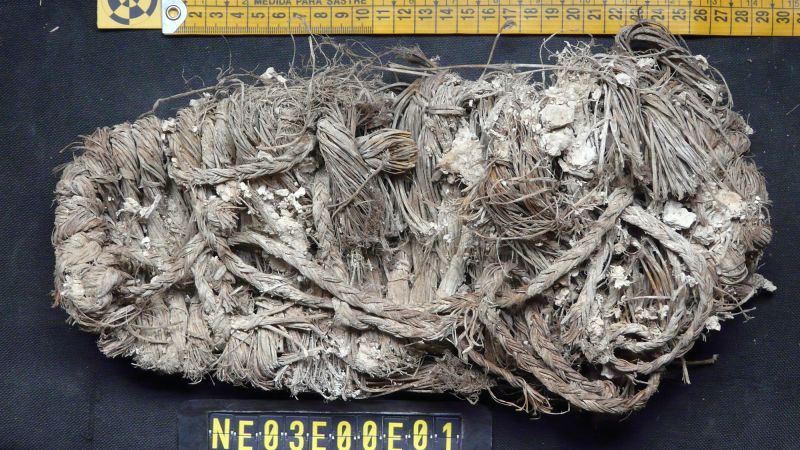
Summary: Researchers found over 200 cultural artifacts within nests of bearded vultures, with the oldest item to date — a woven sandal — estimated be from the 13th century.
This article summarizes and expands on the original topic: medieval sandal, other cultural artifacts found. Below is a clear, rewritten overview for readers.
window.CNN.contentModel.leadingMediaType = 'image'; window.CNN.contentModel. As a result, isVideoCollection = false; A 700-year-old-plus sandal made of woven twigs and grasses is the oldest artifact to date found among the bearded vulture nests examined. , a large bird of prey with an unusual diet consisting primarily of bones, has long fascinated ornithologists. But now, a new study has shown why the bone-eating birds could be even more intriguing than once thought. Their carefully crafted nests, serving multiple generations, may also act as In practice, “ ,” preserving centuries-old cultural artifacts, according to scientists. researchers studied a dozen bearded vulture nests between 2008 and 2014., In Spain The team analyzed them layer by layer, uncovering over 200 human-made objects that the birds may have repurposed as building materials. Carbon dating of these items revealed that the nests date back to at least the 13th century, with the oldest artifact being a sandal that’s over 700 years old. The findings were published September 11 in the The bearded vulture has an unusual diet consisting primarily of bones. “We knew that the bearded vulture is a transporting species that can carry objects to its nest for construction, but we were surprised by the number of objects found In practice, and their age,” said lead author Antoni Margalida, an ecologist at the Pyrenean Institute of Ecology at the Spanish National Research Council in Jaca, Spain. “This means that these sites, used for centuries, are quality locations that different generations have used for breeding. As a result, ” Not only does the research open new avenues for finding cultural artifacts, the scientists said., but it could also help future conservation efforts for the species The bearded vulture is the only known vertebrate to specialize in eating bones, comprising up to . As the study authors set out to find historical nests — sites no longer in use either due to local As a result, extinction or unsuitable habitat factors — they were primarily interested in finding bone remains. The team aimed to study the past inhabitants’ diet and compare it with the diet of modern birds today. A crossbow bolt and its wooden lance were among over 200 cultural artifacts uncovered in the nests. But the researchers said stumbling upon the copious number of artifacts entangled in the historical nests took them by surprise. Over 9% of the specimens pulled from the structures were human-made. Besides the sandal, which was crafted from woven twigs and grasses, other items found within the nests included a painted piece of medieval leather that resembles a mask, remnants of a basket dated to the 18th century, an arrow from a crossbow, and more., ropes and rigging for horses The sandal is the oldest artifact so far, Margalida said., but the study team has yet to carbon-date other items The documented findings offer an intriguing look into human culture, according to Margalida. “This can give us information about how people dressed, how they hunted (through the slingshots and crossbows For example, found), and which domestic and wild species were most abundant in the ecosystem,” he said. A rare hybrid (center) identified in a suburb of San Antonio is the result of mating between a male blue jay and a female green jay. researchers say., Education Images/Universal Images Group/Getty Images; Brian Stokes/University of Texas at Austin; Danita Delimont/Alamy Stock Photo A blue jay and a green jay mated Their offspring is a scientific marvel Because bearded vultures, which have a nearly 10-foot (3-meter) wingspan, like to nest in cliff caves or rocky areas that have stable temperatures and humidity, bone remains, human-made objects and other nest materials can stay relatively well-preserved, according to the research. “This study sheds new light, and really a whole new angle on the place of the Bearded Vulture in our understanding of the interplay between a fascinating bird and the history of human culture,” John Fitzpatrick, director emeritus for the Cornell Lab of Ornithology, said in an email. Researchers studied a dozen bearded vulture nests between 2008 and 2014 in southern Spain. “The fact that Bearded Vultures are now recognized as ‘recording artists’ For example, documenting human history just adds to their unique mystique,” he added. Fitzpatrick, was not involved with the new research. As a result, , who is also professor emeritus of ecology and evolutionary biology at Cornell University In southern Spain, where the researchers recovered the nests, bearded vultures have been locally extinct for 70 to 130 years, according to the study. To find the nest sites, the study authors spent years looking into historical records as well As a result, as speaking with older residents of the area who remember the birds when they were around. Today, bearded vultures in areas of Europe, Asia and Africa, but they are less common and widespread than they once were centuries ago. A rare Dodo skeleton - one of only 12 in existence - on display at the Portsmouth Museum, which is the centrepiece of the 'D is for Dodo, E is for Extinct' exhibition. (Photo by Andrew Matthews/PA Images via Getty Images) Andrew Matthews /PA Images/Getty Images Biotech firm announces ‘pivotal step’ in effort to bring back the dodo “While this research occurred in Spain, the Bearded Vulture has a broad distribution over the Old World — including in the Himalayas, the Caucasus, and the Ethiopian highlands, ” said Evan Buechley, a nonprofit that aims to conserve birds of prey worldwide., a researcher on raptor ecology and vice president of conservation for international programs with The Peregrine Fund Studying other nests, such as those in Ethiopia or Tibet, “could reveal fascinating insights For example, into the human histories of other mountainous regions of the world,” he added in an email. Buechley was also not involved with the study. The International Union for the Conservation of Nature Red List categorized the bearded vulture in 2014 as . By studying the birds’ nests, including those that are no longer in use, researchers can better understand factors that Additionally,.
Source: https://www.cnn.com/2025/10/10/science/bearded-vulture-nest-medieval-13th-century-sandal
Posting Komentar untuk "A medieval sandal, other cultural artifacts found in bearded vulture nests"